OET TIP
OET letter samples: a nursing discharge letter and a medicine referral letter
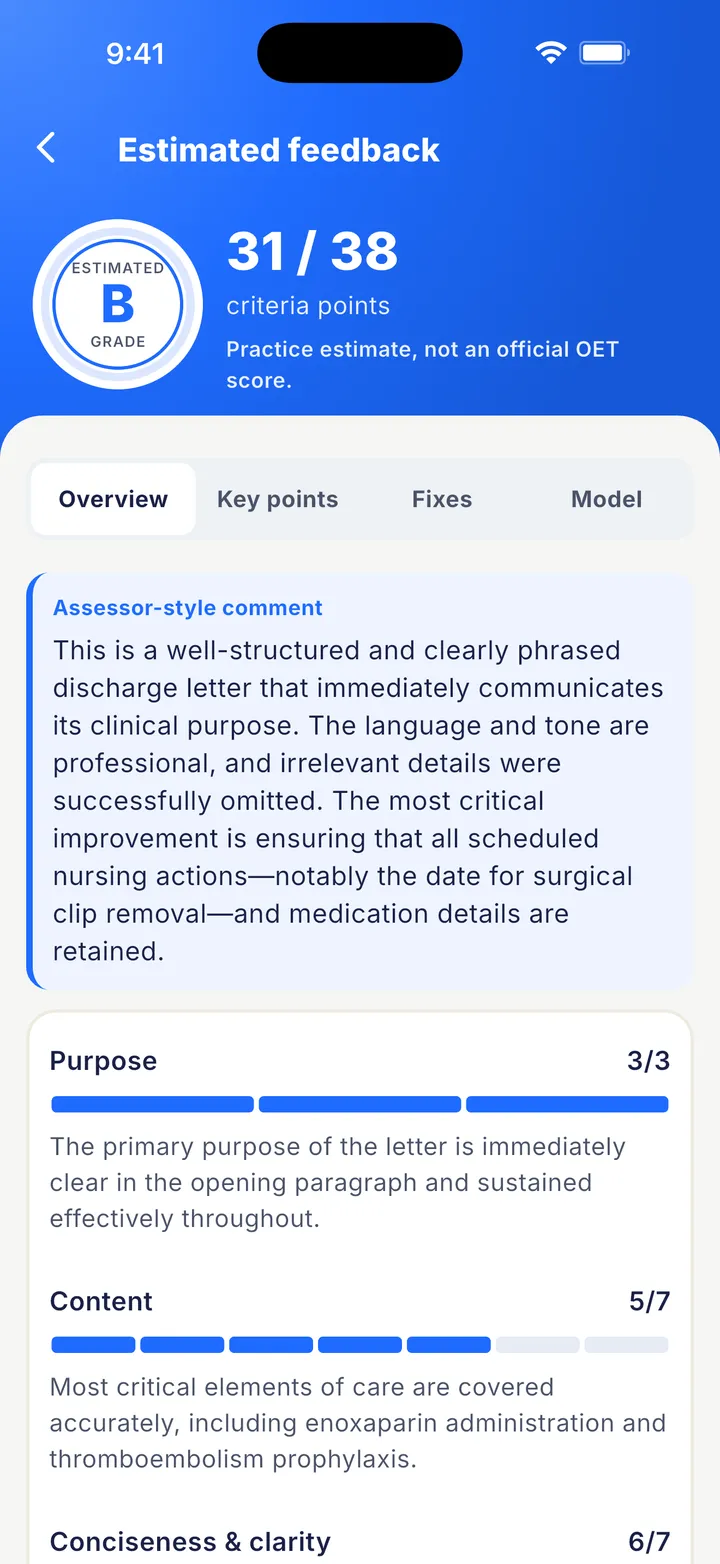
Explore two full samples from real OET TIP practice sets: a nursing discharge letter and a medicine referral letter. Each includes case notes, what to include and leave out, and a model letter, alongside an explanation of the 6 criteria. Nursing set 1 and medicine set 1 are free in the app.
How OET Writing works
- 15 minReading time
- 240 minWriting time
- 3180–200 wordsAbout this length in the letter body
The 6 criteria
Maximum points across the six criteria: 38.
Purpose
The reader understands why you are writing early in the letter.
Content
The letter includes the information the reader needs.
Conciseness & clarity
The information is clear and relevant without unnecessary detail.
Genre & style
The tone and language suit the reader and the clinical context.
Organisation & layout
The information follows a logical order in a clear letter layout.
Language
Grammar, vocabulary, spelling and punctuation communicate the message clearly.
Discharge to community nurse: post-hip replacement care
Your task
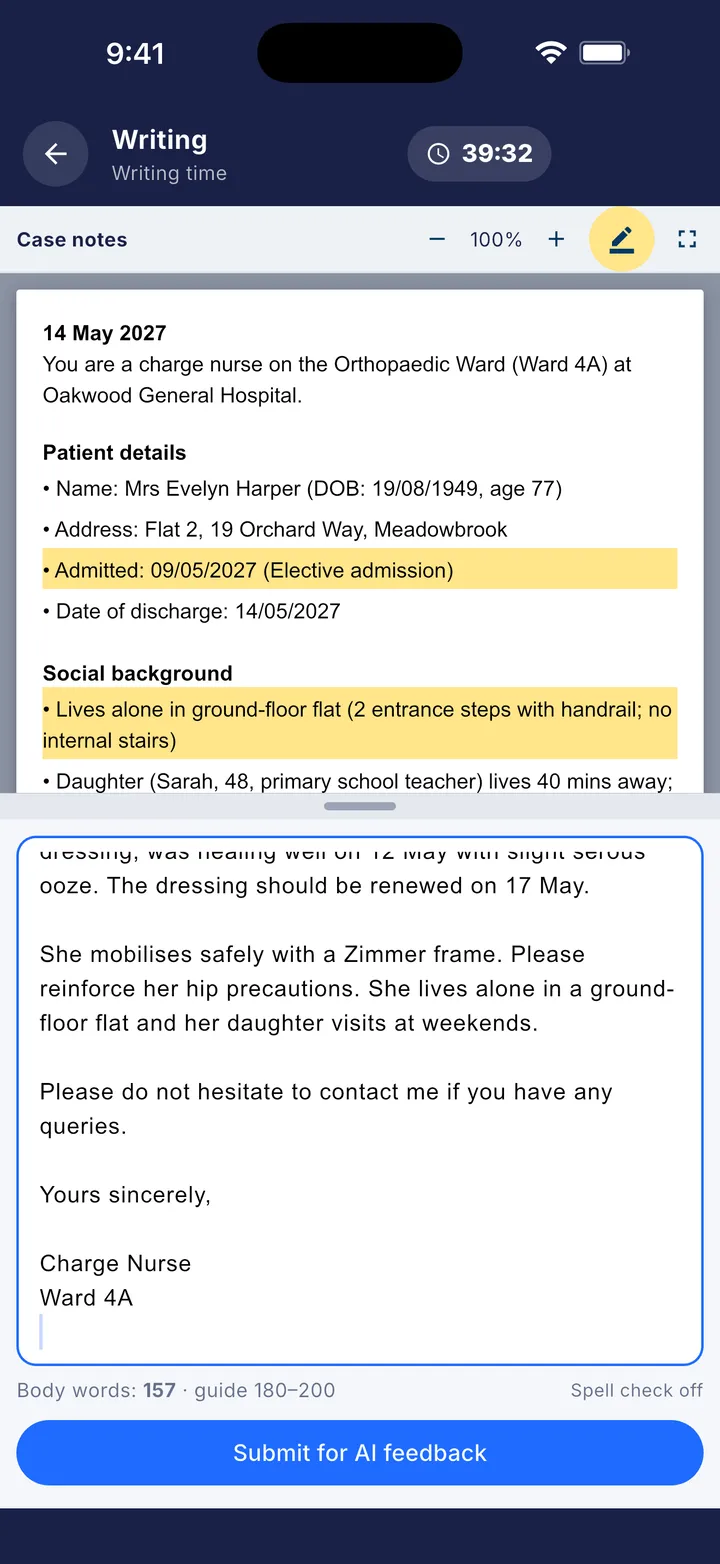
You are a charge nurse on the Orthopaedic Ward (Ward 4A) at Oakwood General Hospital.
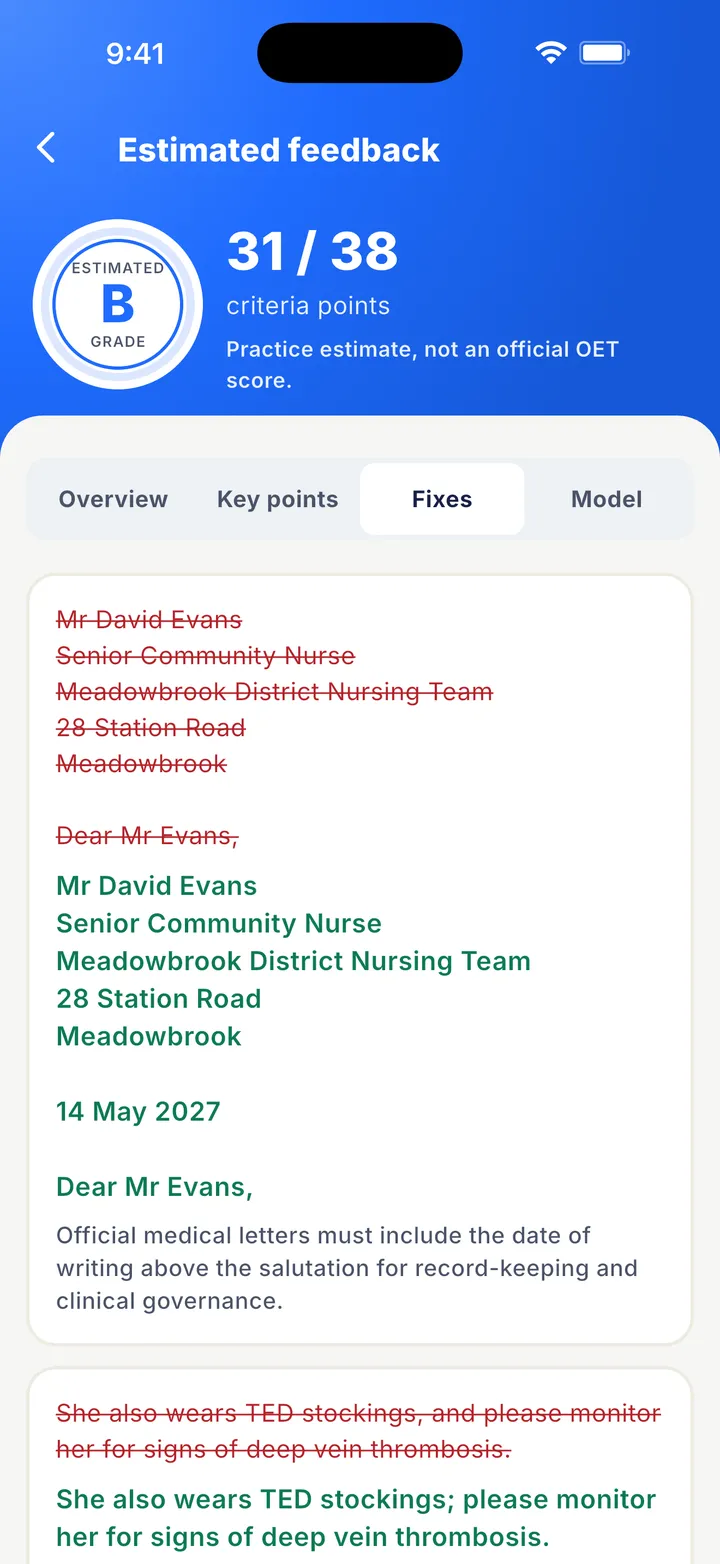
Using the information in the case notes, write a letter to Mr David Evans, Senior Community Nurse, Meadowbrook District Nursing Team, 28 Station Road, Meadowbrook, who will be providing follow-up care.
In your answer: expand the relevant notes into complete sentences; do not use note form; use letter format. The body of the letter should be approximately 180-200 words.
Case notes
Patient details
- Name: Mrs Evelyn Harper (DOB: 19/08/1949, age 77)
- Address: Flat 2, 19 Orchard Way, Meadowbrook
- Admitted: 09/05/2027 (Elective admission)
- Date of discharge: 14/05/2027
Social background
- Lives alone in ground-floor flat (2 entrance steps with handrail; no internal stairs)
- Daughter (Sarah, 48, primary school teacher) lives 40 mins away; can visit at weekends only
- Retired librarian; enjoys crossword puzzles and gardening
- Non-smoker; occasional alcohol (1 glass of sherry on Sundays)
- Previously independent with all ADLs; mobilised with a single walking stick outdoors
Medical history
- Severe R hip osteoarthritis – progressive pain and stiffness over 3 yrs
- Hypertension (well controlled on ramipril 5 mg OD)
- Mild bilateral nodal osteoarthritis of hands
- Past surgical hx: Appendicectomy (1978), L cataract extraction (2021)
- Family hx: Father died of CVA aged 84; mother had T2DM. Allergy: Penicillin (rash)
Admission & surgical management
- 09/05/2027: Uncomplicated R total hip replacement (THR) under spinal anaesthesia (EBL 250 mL)
- Pre-op MRSA screen negative; prophylactic IV cefuroxime completed within 24 hrs
- Post-op Day 1 bloods: Hb 108 g/L (pre-op 124 g/L), U&Es within normal limits; no transfusion needed
- Pain well controlled on regular paracetamol 1 g QDS (PRN codeine 30 mg no longer required)
- VTE prophylaxis: Enoxaparin 40 mg SC OD for 28 days (until 06/06/2027) + TED stockings
- Bowels opened Day 3 post-op following stat dose of senna; normal diet and fluids tolerated
Post-operative nursing & therapy progress
- Wound: 15 cm R lateral hip incision closed with 18 surgical clips; waterproof dressing in situ
- 12/05/2027: Dressing renewed; edges well approximated, slight serous ooze at lower pole, no signs of infection
- Attempted enoxaparin self-injection teaching – pt unable to self-administer due to reduced hand dexterity (OA) and needle anxiety
- Physiotherapy: Mobilising safely and independently up to 30 m using Zimmer frame (weight-bearing as tolerated)
- OT assessment: Provided raised toilet seat and dressing aids; educated on hip precautions (no flexion >90°, adduction, or internal rotation)
- Observations stable throughout admission: BP 128/76 mmHg, HR 72 bpm, afebrile (36.6°C)
Discharge plan
- Discharged home 14/05/2027 with 28-day supply of enoxaparin 40 mg pre-filled syringes, sharps bin, and spare dressings
- Community nurse daily visits requested for SC enoxaparin administration until 06/06/2027 and DVT/TED stocking checks
- Wound care: Inspect and renew dressing on 17/05/2027; clip removal (18 clips) on 23/05/2027 (Day 14 post-op)
- Reinforce hip precautions and safe Zimmer frame mobility at home (community physiotherapy referral sent separately)
- Continue regular paracetamol 1 g QDS as needed and usual ramipril 5 mg OD
- Orthopaedic outpatient follow-up booked for 25/06/2027 with Mr R. Nair (6 weeks post-op)
Include
- 77-year-old woman (Mrs Evelyn Harper) discharged home on 14/05/2027 after an elective right total hip replacement on 09/05/2027
- Lives alone in a ground-floor flat with family support from her daughter available at weekends only
- Requires daily community nurse visits to administer subcutaneous enoxaparin 40 mg OD until 06/06/2027 (pre-filled syringes and sharps bin supplied), as she cannot self-inject due to hand osteoarthritis and needle anxiety
- Wears TED stockings for venous thromboembolism prophylaxis and requires monitoring for signs of deep vein thrombosis
- Right hip wound (18 surgical clips under a waterproof dressing) was well approximated on 12/05/2027 with slight serous ooze at the lower pole and no signs of infection
- Requires wound dressing renewal on 17/05/2027 and removal of the 18 surgical clips on 23/05/2027 (Day 14 post-op)
- Mobilising safely with a Zimmer frame (weight-bearing as tolerated); needs reinforcement of hip precautions and safe mobility at home
- Takes paracetamol 1 g QDS for pain and ramipril 5 mg OD for hypertension, has a penicillin allergy, and has an orthopaedic clinic review booked for 25/06/2027
Leave out
- Daughter's occupation as a primary school teacher and Mrs Harper's former career as a librarian and hobbies (crossword puzzles, gardening)
- Smoking and alcohol history (non-smoker, one glass of sherry on Sundays)
- Remote surgical history of appendicectomy (1978) and left cataract extraction (2021)
- Family medical history of stroke (father) and type 2 diabetes (mother)
- Intraoperative spinal anaesthesia and estimated blood loss (250 mL), negative pre-op MRSA screen, and completed 24-hour IV cefuroxime course
- Routine Day 1 post-operative blood test results (Hb 108 g/L, normal U&Es) requiring no transfusion
- Resolved post-operative constipation (bowels opened Day 3 after senna) and discontinued PRN codeine
- Stable routine inpatient vital signs (BP 128/76 mmHg, HR 72 bpm, temperature 36.6°C)
Model letter
192 body wordsWhitespace-separated words; excludes the address, date, salutation, Re: line and closing.
Model answer from OET TIP practice set, not an official OET sample.
Referral to cardiologist: exertional chest pain and abnormal exercise ECG
Your task
You are a general practitioner at Oakwood Medical Practice.
Using the information in the case notes, write a letter of referral to Dr Eleanor Vance, Consultant Cardiologist, Cardiology Clinic, St Jude's Hospital, 88 Highgate Road, Brookside.
In your answer: expand the relevant notes into complete sentences; do not use note form; use letter format. The body of the letter should be approximately 180-200 words.
Case notes
Patient details
- Name: Mr Arthur Pendelton (DOB: 14/08/1968, age 58)
- Address: 42 Meadow Lane, Brookside
- Occupation: Secondary school history teacher
- Marital status: Married (wife: Sarah, primary school administrator); 2 adult children living away
Social and family history
- Smoking: Ex-smoker (20/day for 25 yrs; quit 3 yrs ago)
- Alcohol: 14–16 units/wk (mostly red wine at weekends)
- Diet & exercise: Sedentary lifestyle; walks dog 15 mins daily; enjoys gardening
- FHx: Father died of acute MI aged 61; mother (84) alive, has osteoarthritis
- Travel: Returned from holiday in Portugal 4 months ago (no health issues)
- Allergies: Nil known drug allergies (NKDA); mild seasonal hay fever (pollen)
Past medical history & regular medications
- 2019: Laparoscopic cholecystectomy for symptomatic gallstones (uncomplicated recovery)
- 2022: Left ankle sprain after slipping on wet steps (resolved with physiotherapy)
- 2023: Hypertension & dyslipidaemia diagnosed at routine health check
- 2025: Mild gastro-oesophageal reflux disease (GORD), occasional symptoms only
- Regular meds: Amlodipine 5 mg OD, atorvastatin 20 mg ON, omeprazole 20 mg PRN
- Immunisations: Annual influenza and COVID-19 boosters up to date
Consultation – 04/05/2027
- PC: 6-wk hx of central chest tightness on exertion (walking uphill or climbing >1 flight of stairs)
- Character: Heavy, constricting retrosternal discomfort; radiates to left shoulder and jaw
- Relieving factors: Settles within 3–5 mins of rest; no pain at rest or nocturnally
- Associated sx: Mild exertional dyspnoea; nil palpitations, syncope, orthopnoea, or ankle oedema
- O/E: BP 148/92 mmHg, HR 76 bpm (reg), BMI 29.4 kg/m²; HS I + II + 0, chest clear
- Resting 12-lead ECG: Normal sinus rhythm, no acute ST–T wave changes
- Plan: Fasting bloods; trial of sublingual GTN spray 400 mcg PRN; book exercise tolerance test (ETT)
Review – 18/05/2027 (Today)
- Sx update: Episodes increasing in frequency (now triggered by brisk walking on flat ground); GTN spray provides prompt relief within 2 mins
- Blood results (06/05/2027): Total cholesterol 5.8 mmol/L, LDL 3.7 mmol/L, HbA1c 41 mmol/mol, FBC & U&Es normal, troponin negative
- ETT report (14/05/2027): Stopped at 6 mins (Bruce protocol Stage 2) due to central chest tightness and breathlessness
- ETT ECG findings: 2.2 mm horizontal ST-segment depression in leads V4–V6 and II, III, aVF at HR 134 bpm; normalised after 4 mins recovery
- O/E today: BP 146/88 mmHg, HR 72 bpm (reg)
- Medications updated today: Commenced aspirin 75 mg OD and bisoprolol 2.5 mg OD; increased atorvastatin to 80 mg ON; continue amlodipine 5 mg OD and GTN spray PRN
Management plan
- Explained likely diagnosis of stable angina / suspected obstructive coronary artery disease
- Advised to avoid strenuous exertion and call 999 if chest pain persists >15 mins despite two doses of GTN
- Urgent referral to Cardiology Clinic for specialist assessment and consideration of coronary angiography
Include
- 6-week history of exertional central chest tightness radiating to the left shoulder and jaw, with mild exertional dyspnoea
- Symptoms settle with rest and sublingual GTN spray (400 micrograms PRN), but have increased in frequency to occur during brisk walking on flat ground
- Cardiovascular risk factors: hypertension, dyslipidaemia, overweight (BMI 29.4 kg/m²), 25-year ex-smoker (quit 3 years ago), and family history of premature MI (father died aged 61)
- Elevated fasting lipids (total cholesterol 5.8 mmol/L, LDL 3.7 mmol/L), with normal resting ECG, routine bloods (FBC, U&Es), HbA1c, and negative troponin
- Exercise tolerance test (14/05/2027) stopped at 6 minutes (Bruce Stage 2) due to chest tightness and dyspnoea
- Exercise ECG showed 2.2 mm horizontal ST-segment depression in leads V4–V6 and II, III, aVF at 134 bpm, resolving within 4 minutes of recovery
- Medication changes: commenced aspirin 75 mg daily and bisoprolol 2.5 mg daily, increased atorvastatin from 20 mg to 80 mg nightly, continuing regular amlodipine 5 mg daily
- Request for urgent cardiology assessment and possible coronary angiography for suspected stable angina
Leave out
- Marital status, wife's occupation (primary school administrator), and two adult children living away
- Mother (84) alive with osteoarthritis
- Holiday in Portugal 4 months ago with no health issues
- Mild seasonal hay fever (pollen)
- Uncomplicated laparoscopic cholecystectomy for gallstones in 2019
- Left ankle sprain in 2022 resolved with physiotherapy
- Mild gastro-oesophageal reflux disease (2025) and PRN omeprazole 20 mg
- Up-to-date annual influenza and COVID-19 booster immunisations
Model letter
189 body wordsWhitespace-separated words; excludes the address, date, salutation, Re: line and closing.
Model answer from OET TIP practice set, not an official OET sample.
Get estimated feedback on your own letter
- An estimated Writing grade with points on the 6 criteria
- Line-by-line fixes for your letter
Coming soon to the App Store and Google Play
Questions
How long should an OET letter be?
The letter body should be about 180–200 words, as stated in the task instructions in these practice sets.
What is the difference between a referral and a discharge letter?
A referral asks a specialist to see the patient. A discharge letter hands over care after a hospital stay. In these samples, the doctor requests cardiology assessment and the nurse requests community nursing follow-up.
Are these official OET samples?
No. These are OET TIP practice sets. Visit oet.com for official materials.
How is OET Writing scored?
The six criteria have a maximum of 38 points: Purpose 3, Content 7, Conciseness & clarity 7, Genre & style 7, Organisation & layout 7, and Language 7. OET reports each sub-test separately as a score from 0 to 500 in steps of 10 and a letter grade from A to E. There is no overall score.